


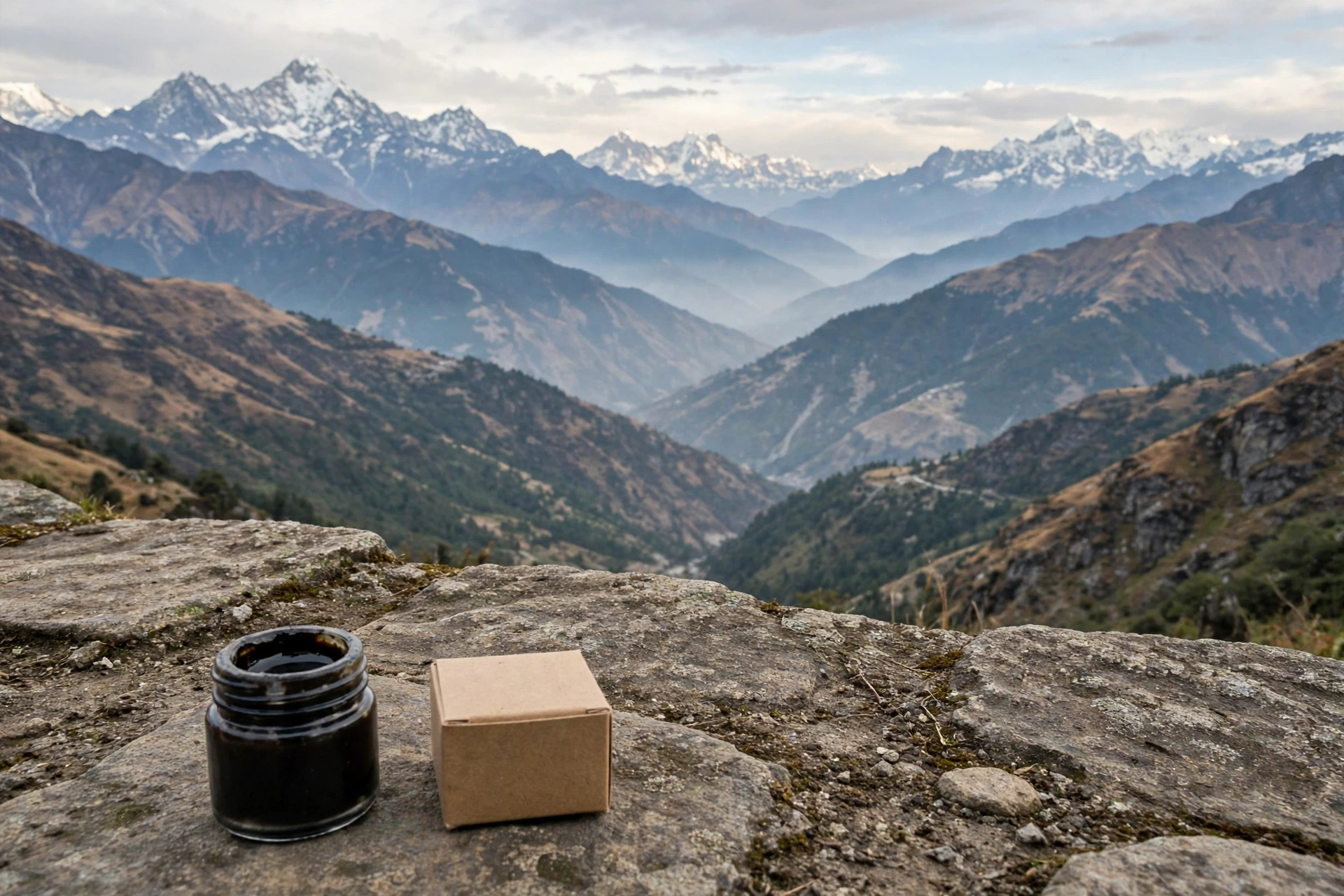
Shilajit has a long history, and that history helps explain why it is still talked about today. It is a natural substance found in high mountain ranges, and people living near those mountains have known about it, collected it and used it in traditional ways for a very long time. This guide traces that story in plain terms: from early mountain collection, through traditional preparation, to the modern forms sold today. It is a history guide, not a recommendation and not a health claim. For background on the substance itself, start with What Is Shilajit?
What Shilajit Is, in Historical Terms
In its natural form, shilajit is a dark substance that seeps from cracks in high mountain rock, and it is traditionally collected in the warmer months, when heat helps it soften and flow from the rock face. Early accounts describe it as a mountain exudate, found in ranges including the Himalaya and Karakoram, and gathered by people who knew the rock faces where it appeared. That simple description has stayed remarkably stable across centuries: a mountain substance, found at altitude, collected by hand, and prepared before use. The name itself reflects that mountain origin. In the languages of the region, traditional names for shilajit often refer to rock, mountains or what comes from stone, and later writers in several traditions repeated those descriptions. Names and stories varied between regions, but the core picture was the same: a rare, dark material from high rocks, valued enough that people made the difficult journey to collect it.
Shilajit in Early Traditional Systems
Shilajit appears in the traditional medical and wellness literature of South Asia, where it was described as a substance used in tonics and preparations over many centuries. In those older texts, it was grouped with other natural materials gathered from mountains, forests and rivers, and its preparation was described as a careful process, not a casual one. Traditional preparation often involved cleaning, dissolving and drying, steps that echo the purification stages described in modern guides. It is important to read those old descriptions as history, not as modern proof. Traditional writers recorded what people believed and practised in their own time, with the knowledge and methods available then. They did not run the kind of controlled studies used today, and their claims about effects should not be read as modern medical evidence. What the old texts do show clearly is that shilajit was not a recent invention. It was known, named and written about long before modern supplement shops existed.
Collection Through the Centuries
For most of its history, shilajit collection was slow, seasonal and local. Collectors travelled to rock faces, often on steep slopes that were difficult to reach, and gathered the material by hand using simple tools. The raw material was carried down from the mountains in small quantities, because the terrain and the season limited how much could be collected. This is why, historically, shilajit was not a mass-produced commodity. It was a mountain product, tied to place, season and the knowledge of the people who knew where to look. That pattern is described in more detail in our guide to How Shilajit Is Sourced and Purified, which explains collection, cleaning and purification in plain terms. The modern version of that journey still starts in the same place: a high rock face, a seasonal window, and careful handling. What has changed most is what happens after collection, as cleaning, filtration, testing and packing have become more systematic.
From Traditional Preparation to Modern Purification
Traditional preparation of shilajit generally involved dissolving the raw material in water, allowing heavier rock particles and debris to settle or be filtered away, and then slowly removing the water to leave a concentrated substance. Different regions and practitioners varied the details, and there was no single universal recipe. The aim, however, was consistent: separate the shilajit itself from the mountain debris that came with it, and produce a stable material that could be stored. Modern purification follows the same broad principle, with more systematic filtration and drying, and with laboratory testing added as a quality check. Testing looks at purity and at the absence of unwanted contaminants, and it is discussed in our guides to How to Spot Pure Shilajit and to the Lab Testing and Purity page. Testing does not turn a traditional substance into a medicine, and it does not prove any health effect. It is a quality step, and it should be described as one. For the science background in general terms, see our guide to What Is Fulvic Acid in Shilajit?
How Modern Forms Developed
For much of its history, shilajit was used in a form close to its purified, sticky state, similar to what is now sold as resin. Resin is the thick, purified substance itself, usually sold in a jar, and it remains the form closest to the traditional material. Powder, capsules and liquid drops came later, as producers looked for ways to make the same purified material easier to store, measure and carry. Powder is dried and ground purified shilajit. Capsules contain a measured amount of powder or extract inside a capsule shell, which some people find more convenient. Liquid drops are a liquid extract, usually sold in a dropper bottle. Each form has its own handling and storage needs, which is why our guides compare them side by side in Shilajit Resin vs Capsules vs Powder vs Drops and explain storage in How to Store Shilajit. The form does not change what shilajit fundamentally is. It changes how it looks, how it is stored, and how convenient it is to handle. On this site, you can browse the four forms in the shop: Pure Shilajit Resin, Pure Shilajit Capsules, Pure Shilajit Powder and Pure Shilajit Liquid Drops. Check the current price, size and details on each product page before ordering, because product details can change.
Shilajit Beyond South Asia
Although shilajit is most closely associated with the Himalaya and with South Asian traditional systems, similar mountain exudates have been described in other high ranges, including parts of Central Asia. Travellers, traders and writers carried descriptions of the substance between regions, and different cultures gave it different names and different traditional uses. Those parallel traditions are a reminder that shilajit was never the property of a single place or a single system. It was a mountain material that several mountain cultures noticed independently. In recent decades, interest in shilajit has spread well beyond its regions of origin, through supplement shops, online sellers and general wellness writing. That wider interest has brought both better information and more confusion: clearer descriptions of sourcing and testing on the one hand, and vague purity claims on the other. The history helps a buyer here, because it gives a simple test. A seller who can explain origin, collection, purification and testing in concrete terms is continuing the careful part of the tradition. A seller who offers only superlatives is not.
Reading Old Claims with Modern Care
Old claims about shilajit need to be read with care. Traditional texts often describe effects in broad, general language, and they reflect the beliefs and practices of their time. Modern readers should not treat those descriptions as dosage advice, as a diagnosis, or as proof that a product will have a particular effect. Our guide to How to Use Shilajit: Dosage, Timing, Tips discusses general handling, and our safety guide, Is Shilajit Safe?, explains why caution matters. Neither guide replaces personal advice from a qualified health professional. A useful habit, when reading any historical claim, is to ask three questions. First, who recorded it, and when? Second, what method, if any, did they use to check it? Third, what would a modern quality check add, such as origin, purification and testing information? Those questions do not dismiss the tradition. They simply separate history from evidence, and they help a buyer judge a modern product on its own merits. K2 Himalayan Shilajit describes its shilajit as sourced from the K2 Karakoram Range in northern Pakistan, and you can read more about the company’s background on the About Us page. For questions about delivery and returns, see the Shipping and Delivery and Refund and Returns Policy pages, and for common questions, the frequently asked questions page. All posts are listed on the blog index.
Why the History Still Matters to a Buyer
The history of shilajit matters for a practical reason: it explains why quality questions are the right questions. A substance collected by hand from high rock faces, prepared through dissolving, filtering and drying, and then sold in several modern forms, will vary unless each stage is done carefully. Origin, purification, testing, form and storage are therefore not marketing details. They are the modern version of the same care that traditional preparation tried to apply, now described in checkable terms. As a general resource on scientific and industrial research in Pakistan, the Pakistan Council of Scientific and Industrial Research (PCSIR) website is a useful reference for understanding what a national research council does. This link is given only as a general resource. It is not a claim that any K2 product was tested by PCSIR.
Conclusion
Shilajit began as a dark substance seeping from high mountain rock, known to mountain communities and recorded in traditional systems long before modern supplement shops existed. Its story runs from hand collection on steep slopes, through traditional cleaning and drying, to modern purification, testing and the four familiar forms: resin, capsules, powder and drops. The tradition explains the interest; modern quality checks explain how to judge a product today. For a buyer, the most useful approach remains the simplest: ask where it came from, how it was purified, what was tested, which form suits your storage and handling needs, and how it should be kept after it arrives.
Disclaimer
This article is general information only. It is not medical advice, and it does not diagnose, treat, cure or prevent any condition. For personal health questions, speak to a qualified health professional.