


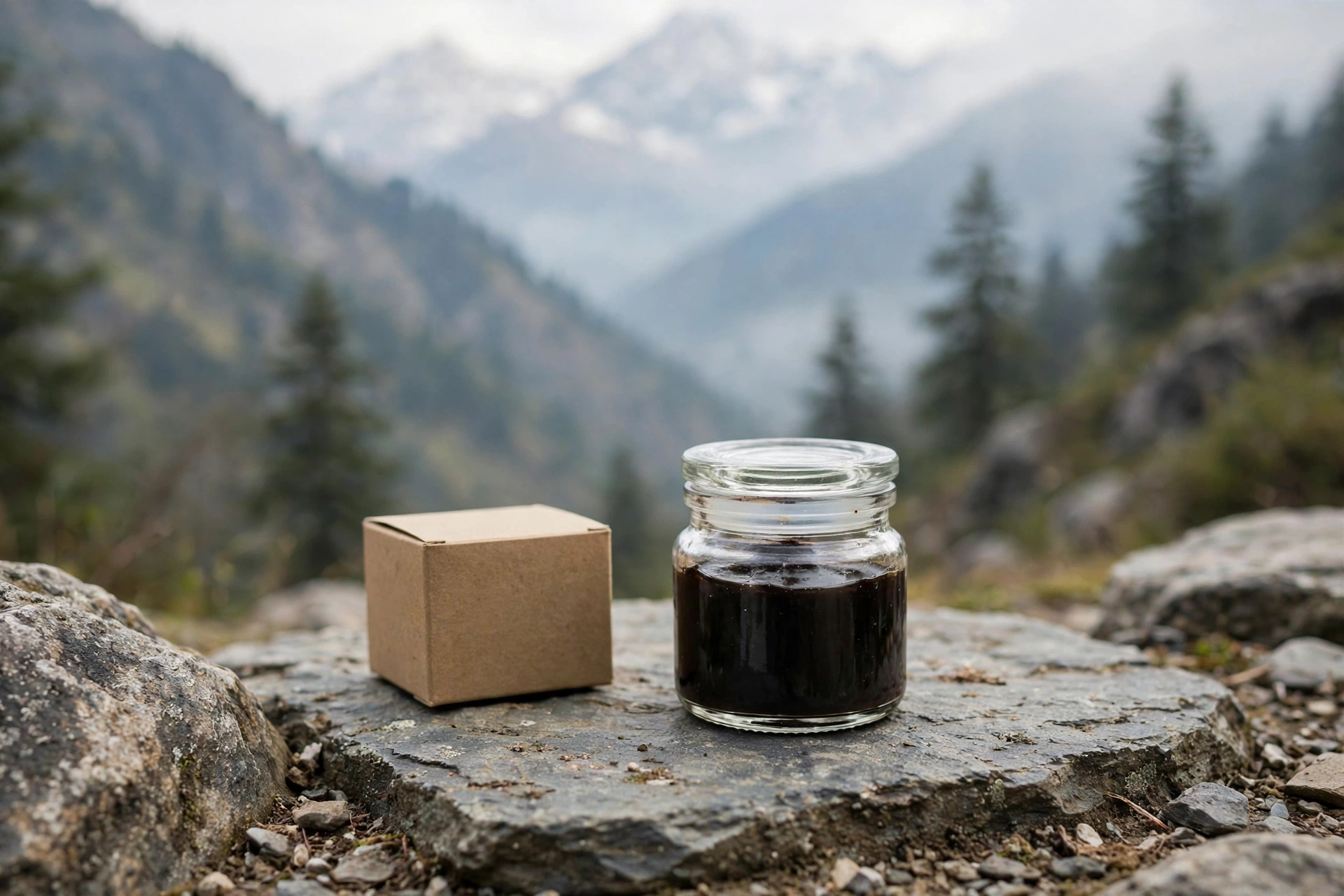
When you open a jar of shilajit resin, it looks like a simple, dark, sticky substance. Behind that jar, however, is a long journey: from a high mountain rock face, through collection, cleaning and purification, to testing and packing. Understanding that journey helps you judge what you are buying, because the quality of shilajit depends less on the jar and far more on where it came from and how carefully it was prepared.
This guide explains, in plain terms, how shilajit is generally sourced and purified. It describes the usual stages used by reputable producers, and it explains what to look for when a seller describes its own sourcing. It does not describe any one producer’s private process in detail, and it makes no health claim about any product. For background on the substance itself, start with What Is Shilajit?
What Shilajit Is in Its Natural Form
Shilajit is a natural substance found in high mountain ranges, including the Himalaya and Karakoram. It appears as a dark exudate that seeps from cracks in rock, and it is traditionally collected in the warmer months, when heat helps it soften and flow from the rock face. In its raw, freshly collected state, it is not yet a finished product. It can contain rock particles, plant debris and other material picked up from the mountain, and it varies in texture and appearance depending on where and when it was collected.
That natural variation is important. Two batches collected from different slopes, or even from the same slope in different seasons, will not look or feel identical. A seller who describes every batch as exactly the same should be treated with caution. Variation is normal for a natural mountain substance, and careful preparation is what turns that variable raw material into a consistent, clean product.
Where Himalayan Shilajit Comes From
Himalayan shilajit is collected at high altitude, in remote and rugged terrain. Collectors travel to rock faces where the substance seeps from cracks, often on steep slopes that are difficult to reach. Collection is traditionally done by hand, using simple tools, and the raw material is carried down from the mountains in small quantities. This is slow, seasonal work, and it is one reason why genuine, carefully prepared shilajit is not a mass-produced commodity.
K2 Himalayan Shilajit describes its shilajit as sourced from the K2 Karakoram Range in northern Pakistan, and you can read more about the company’s background on the About Us page. Whatever seller you consider, the origin matters: the mountain range, the altitude and the collection method all form part of the product’s story. A seller who cannot say where its shilajit comes from, even in general terms, is leaving out the first and most basic piece of information a buyer needs.
From Rock to Raw Material
Once collected, the raw material goes through an initial sorting and cleaning stage. Large pieces of rock and obvious debris are removed, and the material is inspected. At this stage, producers are looking for the cleanest starting material and setting aside anything that is clearly contaminated or unsuitable. This sorting step is unglamorous, but it decides much of what follows: purification cannot fully rescue poor starting material, so careful selection at the start matters.
The cleaned raw material is then prepared for purification. In traditional practice, this involves dissolving the material in water, which allows heavier rock particles and insoluble debris to settle out or be filtered away. The liquid is then separated from the sediment, leaving a cleaner solution to be processed further. Modern producers may use additional filtration steps, but the principle is the same: separate the shilajit itself from the mountain debris that came with it.
Purification: The Key Step
Purification is the most important stage in turning raw shilajit into a finished product. In general terms, the process involves dissolving, filtering and then slowly removing the water, so that what remains is a concentrated, purified substance. The drying stage may use gentle heat or sun drying, depending on the producer’s method, and the aim is to produce a stable resin that can be stored and used. Rushing this stage, or skipping filtration steps, leaves impurities in the finished product, which is why reputable producers describe purification as a careful, multi-step process rather than a single quick step.
There is no single, universal purification recipe, and traditional methods vary between regions and producers. What matters for a buyer is not the exact recipe, which most producers treat as part of their craft, but whether the producer explains its approach at all. A clear description of dissolving, filtering and drying, and of the care taken at each step, is a good sign. Vague claims about purity, with no description of any process, are not.
For more on how purity is presented and checked, see the Lab Testing and Purity page and the Certificates and Lab Tests page, which describe how testing is presented on this site. Those pages are text descriptions of testing; they are not a substitute for asking a seller directly about a specific batch.
Why Lab Testing Matters
Because shilajit is a natural substance collected from rock, testing is the main way a buyer can check that purification was done properly. In general, laboratory testing of shilajit looks at purity and at the absence of unwanted contaminants, such as heavy metals and other impurities that can be present in raw mountain material. Testing may also confirm the general composition of the sample, including the presence of fulvic acid, which is discussed in our guide to What Is Fulvic Acid in Shilajit?
A useful habit is to ask what was tested, by whom, and for which batch, rather than accepting a general claim that a product is tested. A certificate or lab report that cannot be linked to a product or batch tells you less than it appears to. Equally, a seller who refuses to discuss testing at all is giving you a clear signal. Testing does not make a product a medicine, and it does not prove any health effect. It is simply a quality check, and it should be described as one.
As a general resource on scientific and industrial research in Pakistan, the Pakistan Council of Scientific and Industrial Research (PCSIR) website is a useful reference for understanding what a national research council does. This link is given only as a general resource. It is not a claim that any K2 product was tested by PCSIR.
How the Four Common Forms Are Made
Once purified, shilajit is prepared in different forms, and the form affects how it looks and how it is stored, not what it fundamentally is. Resin is the thick, sticky, purified substance itself, usually sold in a jar. Powder is dried and ground purified shilajit. Capsules contain a measured amount of powder or extract inside a capsule shell, which some people find more convenient. Liquid drops are a liquid extract, usually sold in a dropper bottle. Each form has its own handling and storage needs, which is why our guides compare them side by side in Shilajit Resin vs Capsules vs Powder vs Drops.
On this site, you can browse the four forms in the shop: Pure Shilajit Resin, Pure Shilajit Capsules, Pure Shilajit Powder and Pure Shilajit Liquid Drops. Check the current price, size and details on each product page before ordering, because product details can change. Do not judge a form by its jar or bottle alone. The same purification and testing questions apply to resin, powder, capsules and drops alike.
How to Read a Seller’s Sourcing Claims
Sourcing claims are easy to write and hard to check, so it helps to read them with a few simple questions in mind. First, does the seller name an origin, such as a mountain range, rather than just saying pure or Himalayan? Second, does it describe collection and purification in concrete terms, such as hand collection, dissolving, filtering and drying, rather than in vague superlatives? Third, does it explain testing in a way that can be checked, such as what was tested and for which batch? Fourth, does it describe storage and handling, so you know how the product should be kept after it arrives?
Our guide to How to Spot Pure Shilajit covers practical checks in more detail, and our guide to How to Store Shilajit explains how the different forms should be kept once they reach you. Together with this guide, they give you a practical checklist: origin, purification, testing, form and storage. A seller who answers all five clearly is giving you something real to judge. A seller who answers none of them is asking you to take purity on trust.
Storing Shilajit After It Arrives
Purification does not end the story. Once shilajit reaches you, how it is stored affects its condition. Resin should be kept in its jar, away from heat and moisture, and powder, capsules and drops each have their own storage needs. The full details are in the storage guide linked above, and the general rule is simple: follow the storage advice for your form, keep the product in its original container, and keep it out of reach of children. If a product arrives damaged, leaking or with broken packaging, contact the seller before using it, and check the Shipping and Delivery and Refund and Returns Policy pages for the site’s delivery and returns information.
If you have questions about a product, the frequently asked questions page covers common topics, and you can browse all posts on the blog index.
Conclusion
Shilajit begins as a dark substance seeping from high mountain rock, and it becomes a finished product only through careful collection, sorting, purification, testing and packing. Each stage matters, and no stage can be skipped without affecting the result. For a buyer, the most useful approach is also the simplest: ask where it came from, how it was purified, what was tested, which form suits your storage and handling needs, and how it should be kept after it arrives. A seller who answers those questions clearly is doing the most important part of sourcing well, which is being open about it.
Disclaimer
This article is general information only. It is not medical advice, and it does not diagnose, treat, cure or prevent any condition. For personal health questions, speak to a qualified health professional.