


Introduction
When people first learn about shilajit, one term appears again and again: fulvic acid. It is often described as the key compound that helps to explain why shilajit is discussed so differently from a simple mineral powder or a single-ingredient supplement. This guide explains, in plain and general terms, what fulvic acid is, where it comes from in shilajit, how it relates to the different forms of shilajit, and how a reader can think about purity without relying on appearance alone. This article is for general information only and is not medical advice. It does not diagnose, treat, or promise any result for any person, and anyone with a health question should speak with a qualified health professional. For background on the wider subject, start with the What Is Shilajit guide, and return to the K2 Himalayan Shilajit homepage for an overview of the range discussed on this site.
What is fulvic acid
Fulvic acid is a natural organic compound that belongs to a family of substances known as humic substances. Humic substances form when plant and other organic matter breaks down slowly over a very long time. In everyday language, fulvic acid can be thought of as one part of that decomposed organic material that remains after long natural processes have changed its structure. It is not a single, simple molecule with one fixed shape. Instead, the term covers a group of related organic compounds that share certain general characteristics, including a relatively small molecular size compared with related humic acids and a tendency to dissolve in water across a wide range of conditions. That solubility is one reason fulvic acid receives so much attention in discussions of shilajit. In a natural resin, compounds that dissolve readily are easier to observe, to mix, and to study than compounds that remain locked in an insoluble mass. Fulvic acid is also discussed in general science writing because of its interaction with minerals. In broad terms, it can bind with mineral particles and carry them in solution, a process often described using the word chelation. This does not mean that every product containing fulvic acid behaves in the same way, and it does not turn a general chemical description into a personal health claim. It simply explains why researchers and writers focus on fulvic acid when they try to describe what makes shilajit chemically interesting.
Where fulvic acid comes from in shilajit
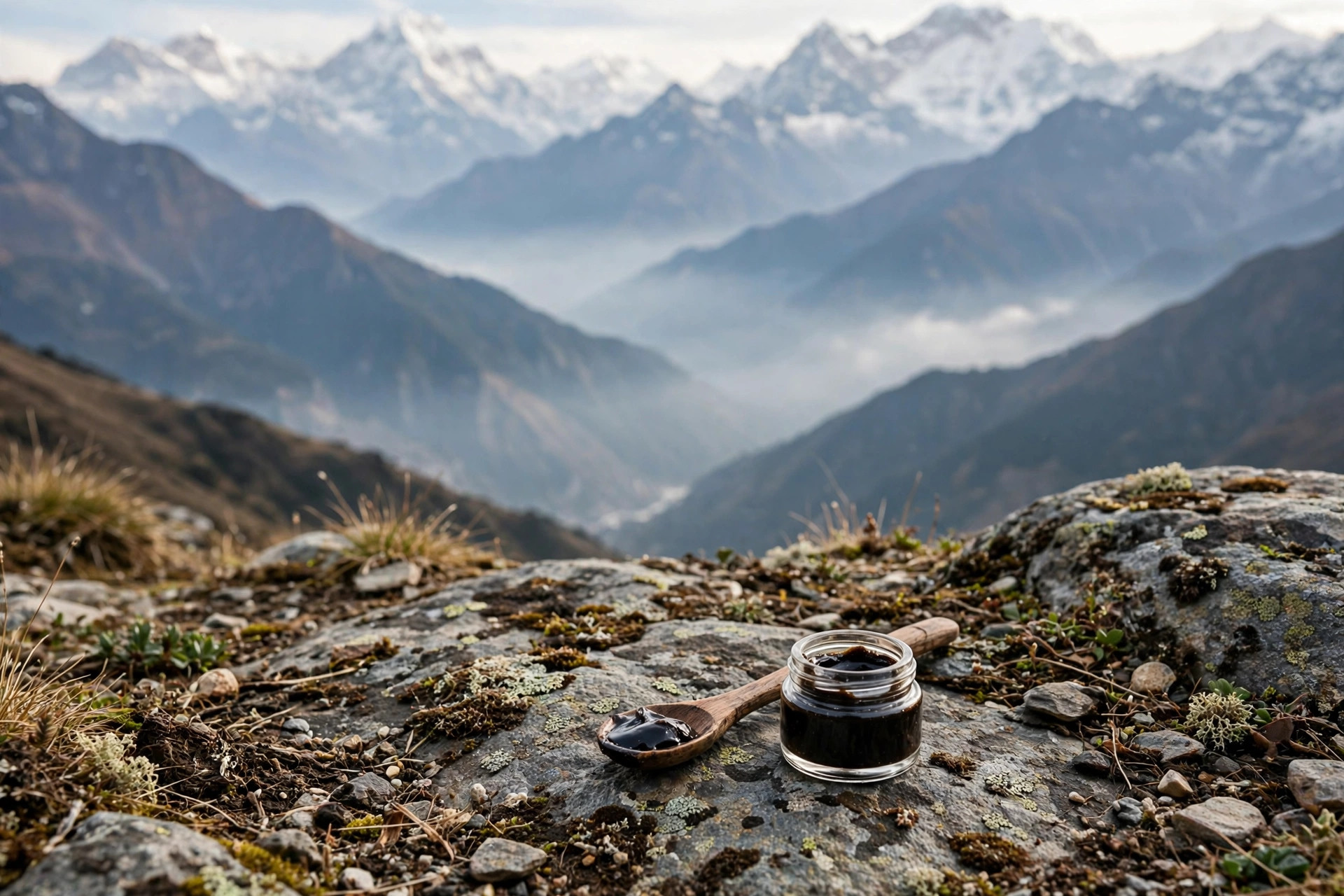
Shilajit itself is a dark, resin-like material that is traditionally collected from mountain rock. The usual explanation is that it forms over very long periods as plant matter, mosses, and other organic material become trapped in rock layers, are compressed, and are gradually transformed by heat, pressure, and microbial activity. Over time, that material changes into a complex mixture that includes humic substances, minerals from the surrounding rock, and other organic compounds. Fulvic acid is one fraction of that mixture. It is therefore best understood as a product of slow natural decomposition rather than as an ingredient that is added later. The mountain environment matters to this general story because altitude, rock type, climate, and time all shape the starting material and the conditions under which it changes. That is why two samples described as shilajit can still differ in colour, texture, smell, and behaviour when dissolved. Those differences do not, by themselves, prove that one sample is pure and another is not. They do help to explain why fulvic acid is used as a talking point in quality discussions: it is a naturally occurring part of the material, and its presence is consistent with the traditional account of how shilajit forms. At the same time, a single word on a label is not a complete description of a complex natural substance, and readers should look for broader information about sourcing and testing rather than relying on one term alone.
Why it matters in pure shilajit
In discussions of pure shilajit, fulvic acid matters mainly as a marker of character rather than as a magic ingredient. A material described as pure is usually meant to be free from added fillers, binders, and unrelated substances, and to retain the natural mixture that was collected and processed. Within that mixture, fulvic acid is one of the compounds that writers point to when they explain why shilajit is not just powdered rock. It helps to explain its dark colour, its behaviour in warm water, and its place in traditional descriptions that treat shilajit as a complex natural resin rather than as a single mineral. Another reason it matters is that it gives readers a useful question to ask. Instead of asking only whether a product looks dark or thick, a reader can ask how the product is described, what testing information is available, and whether the seller explains the source and processing in clear terms. The Lab Testing and Purity page sets out the general approach to testing and purity on this site, and it is a useful companion to this explainer. Remember that fulvic acid is only one part of a much wider picture. A thoughtful assessment also considers the overall composition, the clarity of the information provided, and whether claims are kept general and proportionate rather than exaggerated.
Fulvic acid in resin, capsules, powder and liquid drops
The same basic material can be presented in several forms, and the form changes how a product looks, feels, and is used, even when the underlying discussion of fulvic acid remains the same. Pure Shilajit Resin is the most traditional presentation: a thick, tar-like resin that is usually dissolved before use. Because resin is close to the collected material, it is often used as the reference point when people talk about texture, solubility, and appearance. Shilajit Capsules present a prepared extract in a measured capsule, which some readers prefer because the capsule hides taste and removes the need to handle sticky resin. Shilajit Powder is a dried, finely ground form that can be mixed into a drink or food, and it is often chosen for flexibility in everyday routines. Shilajit Liquid Drops are a liquid presentation that is already in solution, which makes them easy to add to water. None of these forms changes the general definition of fulvic acid, but processing can affect how a product behaves. Drying, extraction, and dilution can all change concentration, texture, and taste, so a comparison between forms should focus on practical differences and on the information provided about each product, rather than on an assumption that one form is automatically superior to another. For practical guidance on using these forms in general terms, see the companion article on how to use shilajit, linked in the questions section below.
How to judge purity in general terms
Judging purity is not a single test that a reader can perform at home with confidence. Colour, smell, and solubility can offer hints, but they are influenced by many factors, including temperature, water, and the form of the product. A more reliable general approach is to look for transparency. Clear information about sourcing, processing, and testing helps a reader understand what is being offered. Lab reports, where they are published, should be read carefully: note what was tested, when the test was carried out, and whether the report relates to a specific batch or to a general product description. Readers can also compare the language used across sellers. Vague claims, absolute promises, and a lack of detail about testing are reasons to ask further questions, while measured language and accessible documentation are generally more helpful. The Certificates and Lab Tests page and the article How to Spot Pure Shilajit provide further general guidance on this topic. As a general lab-testing resource in Pakistan, readers may also wish to know about the Pakistan Council of Scientific and Industrial Research (PCSIR), a government organisation involved in scientific and industrial research. This link is provided only as general background on lab-testing resources in Pakistan. It is not a claim about any particular product or batch. Finally, remember that purity in general terms is about the absence of unrelated additions and the clarity of the information supplied, not about a single visual trick or a single number on a label.
Frequently asked questions
Is fulvic acid the same as shilajit? No. Fulvic acid is one component found within shilajit, while shilajit is a much broader natural mixture that includes other organic compounds and minerals from its source environment. Thinking of fulvic acid as a part of shilajit, rather than as a synonym for it, gives a more accurate picture.
Does every form of shilajit contain fulvic acid? In general terms, fulvic acid is discussed as a characteristic part of shilajit, but the amount and behaviour can vary with source, processing, and presentation. Resin, capsules, powder, and liquid drops are prepared differently, so a reader should check the product description for each form rather than assuming that all presentations are identical.
Can I judge fulvic acid content by colour alone? No. Dark colour is common in shilajit, but colour alone does not measure composition. Testing information, sourcing detail, and clear product descriptions are more useful guides than appearance on its own.
Where can I learn more about using shilajit in general? The article How to Use Shilajit offers general background, and the FAQ page answers common questions in short form. Both are general guides, not personal recommendations.
Conclusion
Fulvic acid is best understood as a key natural compound within pure Himalayan shilajit, formed through the slow breakdown of organic matter in mountain rock over a long period. It helps to explain why shilajit is described as a complex resin rather than as a single mineral, why it dissolves in the way it does, and why it features so often in discussions of quality. At the same time, it should not be treated as a shortcut for judging a product. Form, processing, sourcing, and testing information all matter, and a careful reader will weigh them together. By keeping the explanation general, checking the information provided, and seeking professional advice for personal health questions, readers can approach fulvic acid with a clearer and more balanced understanding of this much-discussed compound in pure Himalayan shilajit.
Disclaimer
Disclaimer: This article is for general information only and is not medical advice. It does not diagnose, treat, cure or prevent any condition, and it is not a substitute for advice from a qualified health professional. Please speak with a qualified health professional about any personal health question, and check the current product information on the linked product pages before making a purchase decision.